
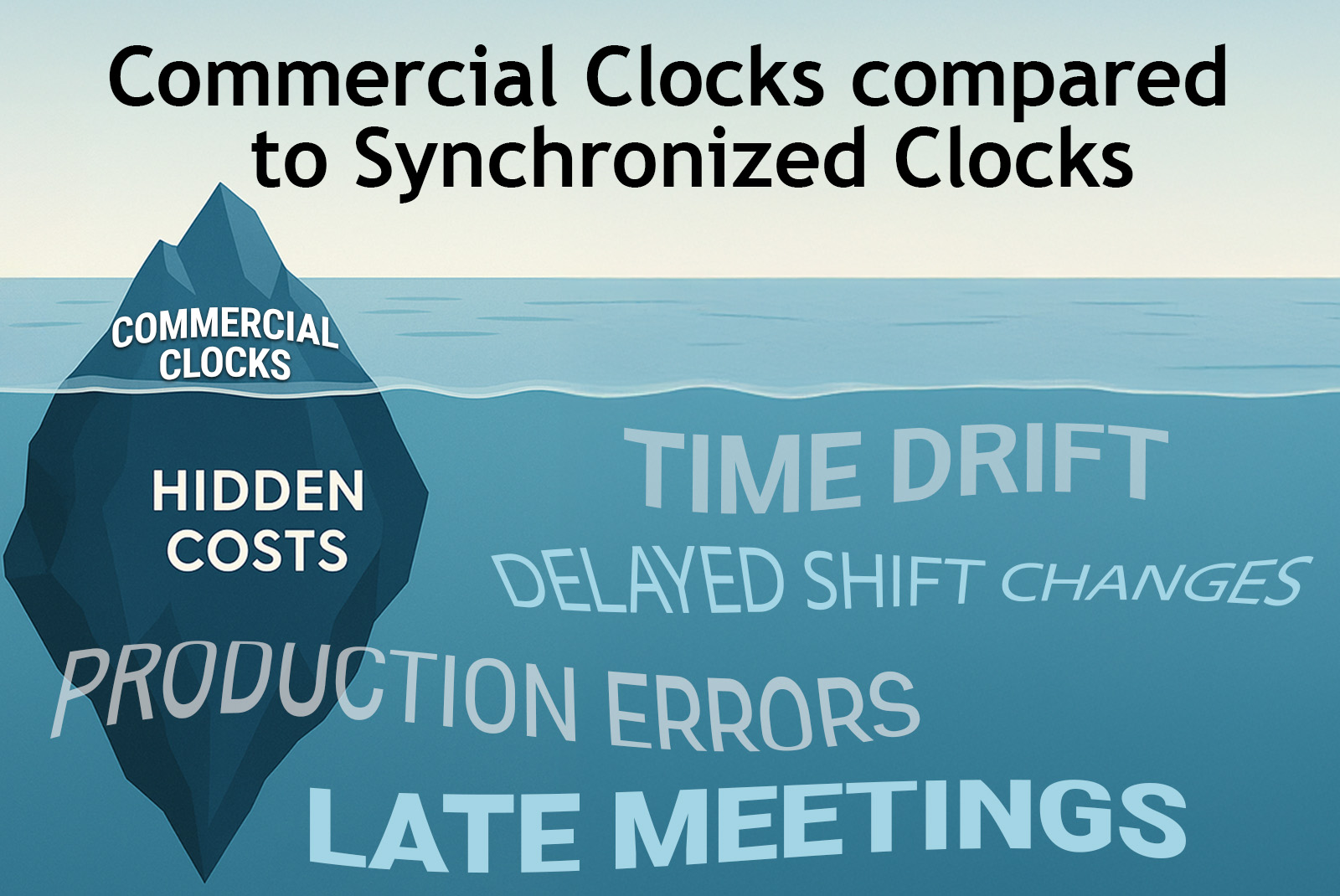
The main difference between commercial clocks and synchronized clocks is accuracy and control. Commercial clocks — the off-the-shelf wall clocks you buy online or at a retail store — run independently on battery or AC power with no connection to a central time source. Over time, they drift, sometimes by several minutes, and each clock drifts differently. A synchronized clock system, by contrast, connects every clock in your facility to a single master time source so they all display the exact same time, automatically. While commercial clocks cost less upfront, they create hidden operational costs — payroll disputes, scheduling errors, compliance risk, and hours of manual adjustment — that a synchronized system eliminates entirely. Below, we break down exactly where commercial clocks fall short and why businesses in healthcare, education, manufacturing, and more are switching to synchronized timekeeping.
Buying a few clocks off the shelf or online seems like a simple, low-cost solution. But commercial clocks are designed for homes, not facilities. They run on batteries or plug into AC power, and each clock relies on its own internal quartz movement to keep time. There is no connection between clocks and no central time source keeping them in sync.
The result is time drift, every quartz clock gains or loses a small amount of time each day. Over weeks and months, clocks across your facility show different times. The breakroom might be three minutes behind the production floor. The front lobby might be off by five minutes. The more clocks you add, the worse the problem gets.
Here are the specific problems commercial clocks create in a business setting:
Uncontrolled drift: Each clock drifts independently. There is no way to know which clock is correct without manually checking against a reference time source.
No central control: You cannot update, adjust, or monitor commercial clocks remotely. Every change requires someone to physically walk to each clock.
Manual Daylight Saving Time resets: Twice a year, someone must visit every clock in the building and adjust it by hand. In a facility with 50–200 clocks, this is hours of labor that a synchronized system eliminates automatically.
Battery maintenance: Commercial clocks run on batteries that die at unpredictable intervals, leaving blank or frozen clock faces throughout the facility until someone notices and replaces them.
No audit trail: In regulated industries (healthcare, food processing, government), commercial clocks provide no verifiable proof that the time displayed was accurate at any given moment.
These are not minor inconveniences. In facilities where time affects safety, payroll, compliance, or production throughput, the hidden costs of commercial clocks add up fast.
When clocks across a facility show different times, the consequences go far beyond appearance. Inaccurate clocks create measurable operational problems that vary by industry. Here is how commercial clock drift impacts the industries that depend most on accurate time:
Healthcare: Hospitals and clinics depend on precise time for medication administration, patient handoffs, surgical scheduling, and time-of-death documentation. When clocks across departments are out of sync, timestamps on medical records become inconsistent — creating HIPAA compliance risk and potential liability for delayed care. Learn how synchronized clocks support healthcare facilities.
Education: Inaccurate clocks in schools disrupt bell schedules, class transitions, and standardized testing windows. Teachers struggle to pace lessons, students arrive late to the wrong class, and campus-wide announcements miss their mark. Testing compliance is at risk when clocks in different rooms show different times. See synchronized clock solutions for education.
Food Processing: Food processing plants operate under strict FDA and USDA regulations that require accurate timestamps on production logs, HACCP records, temperature checks, and batch tracking. When clocks on the production floor, cold storage, and quality control labs drift apart, audit trails break down and the facility faces regulation violations and severe fines. See synchronized clock solutions for food processing.
Manufacturing: Production lines depend on precise shift changes and break schedules. When clocks drift, teams overlap or leave gaps between shifts, creating idle machine time, labor-tracking errors, and payroll disputes. In 24-hour operations, even a few minutes of drift per shift change compounds into hundreds of lost production hours annually. Explore synchronized clock solutions for manufacturing.
Government: Federal, state, and municipal buildings require consistent timekeeping for public service windows, interdepartmental coordination, security logging, and audit compliance. Inaccurate clocks undermine scheduling discipline and produce defensible-timestamp gaps that auditors flag. See synchronized clock solutions for government.
Distribution: Warehouses and fulfillment centers coordinate shift schedules, loading dock timing, and freight dispatch across large, multi-building facilities. Clock drift causes missed shipping windows, delayed handoffs, and unreliable labor tracking that complicates payroll. See synchronized clock solutions for distribution.
Business & Corporate Offices: In office environments, clock discrepancies cause meetings to start late, conference rooms to turn over inefficiently, and employee punch-ins to be disputed. For multi-site organizations, inconsistent time across locations creates payroll headaches and scheduling confusion. See synchronized clock solutions for business.
Sports & Athletics: Athletic facilities, fitness centers, and sports complexes rely on accurate time for training sessions, game clocks, locker room schedules, and event coordination. When clocks across the weight room, practice field, and front desk disagree, scheduling conflicts and athlete confusion follow. See synchronized clock solutions for sports facilities.
In every one of these industries, the cost of inaccurate time is real and measurable. Commercial clocks cannot solve these problems because they were never designed to.
The best way to understand the difference between commercial clocks and synchronized clocks is to compare them side by side across the factors that matter most in a business environment:
Time accuracy: Commercial clocks drift independently — each clock gains or loses time at its own rate, so no two clocks in your facility show the same time. Synchronized clocks, by contrast, all display the exact same time, all the time, because they are connected to a single master time source.
Central control: Commercial clocks are standalone devices with no way to manage them remotely. Synchronized clock systems connect every clock to a master clock or time server, giving you centralized control over your entire facility from one point.
Daylight Saving Time: With commercial clocks, someone must manually reset every clock in the building twice a year. Synchronized clocks update automatically — all clocks adjust simultaneously with no manual intervention.
Battery and maintenance: Commercial clock batteries die at unpredictable intervals, leaving blank or frozen clock faces until someone notices and replaces them. PoE synchronized clocks need no batteries at all (they are powered through the Ethernet cable), and wireless synchronized clocks use long-life batteries with low-battery alerts so you are never caught off guard.
Installation: Commercial clocks require nothing more than hanging on a wall — but that simplicity comes at the cost of accuracy and control. Wireless (RF) synchronized clocks are nearly as simple to install with no wiring between clocks, while PoE synchronized clocks require just a single Ethernet cable per clock.
Scalability: With commercial clocks, every clock you add increases the drift problem and the maintenance burden. With a synchronized system, adding clocks is easy — each new clock auto-syncs to the master clock the moment it is installed.
Compliance and audit readiness: Commercial clocks provide no verifiable proof that the time displayed was accurate at any given moment. Synchronized clocks deliver facility-wide consistent timestamps that meet the documentation requirements of regulated industries including healthcare, food processing, and government.
Long-term cost: Commercial clocks are low cost upfront but carry high hidden costs over time — ongoing labor for manual adjustments, payroll errors from drift, compliance penalties, and battery replacements. Synchronized clocks have a higher initial investment but dramatically lower total cost of ownership because they eliminate all of those recurring expenses.
Pyramid Time Systems offers three main synchronization technologies to fit any facility:
Wireless (RF) clocks — Receive time from a central transmitter. No wiring between clocks. Ideal for retrofitting existing buildings, schools, and warehouses.
Power over Ethernet (PoE) clocks — Connect to your existing Ethernet network. A single cable provides both power and time data. Best for newer buildings with robust network infrastructure.
Legacy upgrade / replacement clocks — Drop-in replacements that work with your existing wired clock infrastructure, letting you modernize without ripping out old cabling.
In every case, the synchronized system pays for itself by eliminating the ongoing labor, errors, and compliance risk that commercial clocks create.
Commercial clocks are tempting because they are inexpensive and easy to find. But once a business starts relying on visible time for operations — shift changes, patient care, production scheduling, or compliance documentation — those clocks become a liability rather than a tool.
Organizations switch to synchronized clocks when they recognize that the total cost of commercial clocks (ongoing battery replacements, manual DST adjustments, payroll disputes from drift, and compliance risk) exceeds the one-time investment in a synchronized system. Most facilities recover that investment within 6–12 months through reduced labor costs and eliminated errors alone.
Pyramid Time Systems offers synchronized clock solutions that fit any building, any budget, and any industry. Whether you need a wireless RF system for an older building, PoE clocks for a modern facility, or a drop-in upgrade for an existing wired system, Pyramid has a reliable, proven solution.
Contact the Pyramid Time Systems team to discuss which system is right for your facility, or read our guide to the ROI of synchronized clock systems to see the numbers behind the switch.
Go to
Clock type
Sync Accessories
Software Based
Manual Punch
Time Clock Supplies


